What Is Therapeutic Humor?
Therapeutic humor is the intentional use of laughter, playfulness, and light-hearted perspective to support physical, emotional, and spiritual well-being. It is not about forcing people to be funny or denying pain. It is about creating space for joy even in difficult seasons.
For decades, nurses, chaplains, physicians, and community leaders have used humor as a bridge — reducing anxiety, easing social isolation, lowering stress hormones, and helping people reconnect with hope. In nursing homes, hospitals, churches, and living rooms, a shared laugh can shift the entire atmosphere.
If you are exploring this path yourself, you may find inspiration in the practical work of bringing laughter into senior communities and ministry settings. Learn more about ongoing laughter ministry and training through the Laughing Chaplain resources at thegarnet.net.
The Science of Laughter
Decades of research have moved therapeutic humor from anecdote to evidence. Here are some of the measurable effects:
Why Laughter Heals
Body
- Temporarily boosts immune markers (natural killer cell activity)
- Relaxes muscles and eases tension for up to 45 minutes
- Can improve pain tolerance through endorphin release
- Supports healthier breathing patterns and oxygen exchange
- Lowers blood pressure in regular practitioners
Mind & Spirit
- Interrupts cycles of worry and rumination
- Builds connection and belonging among groups
- Restores a sense of perspective during crisis
- Opens space for gratitude, hope, and creativity
- Strengthens resilience and emotional regulation
Pioneers of Healing Humor
These men and women helped move laughter from the comedy stage into hospitals, research labs, and everyday caregiving. Each one showed that joy is not frivolous — it is foundational.


Norman Cousins 1920 – 1990
Author of the landmark book Anatomy of an Illness. After a serious collagen disease diagnosis, Cousins checked himself out of the hospital and prescribed himself Marx Brothers films and high doses of vitamin C. He later documented how sustained laughter correlated with reduced pain and improved sleep. His story helped legitimize the idea that attitude and emotion influence physiology — a foundational text for all of therapeutic humor.
Hunter "Patch" Adams b. 1945
Physician, clown, and founder of the Gesundheit Institute in Georgia, USA. Patch Adams became widely known for treating patients with compassion, absurdity, and genuine human connection rather than clinical distance. His life's work argues that medicine without joy is incomplete. His story was immortalized in the 1998 film Patch Adams, bringing healing humor to millions worldwide.
Dr. Madan Kataria b. 1955
Indian physician who founded Laughter Yoga in the mid-1990s. Kataria combined voluntary laughter exercises with yogic breathing, creating a practice that does not require jokes or humor to produce the physiological benefits of laughter. Laughter Clubs now exist in more than 100 countries. Many facilitators continue to train directly in this tradition — including through programs connected to the Laughtarian movement and the Laughing Chaplain pathway.
Allen Klein b. 1938
Known as "Mr. Jollytologist." After the death of his young wife, Klein discovered that humor helped him and others navigate grief. He went on to write several books and speak internationally about the role of therapeutic humor in healthcare and daily life. His work gave humor a vocabulary in clinical settings.
Paul E. McGhee, PhD
One of the leading researchers and educators in the field of humor and health. McGhee developed practical programs showing how people can deliberately cultivate a more playful and resilient sense of humor as a life skill. His "Humor as a Life Skill" curriculum is still used in schools and clinics today.
Dr. Lee Berk & Dr. Stanley Tan
Their research in the 1980s and 1990s at Loma Linda University helped establish measurable connections between laughter and immune function, including changes in natural killer cell activity and stress hormones. Their work gave scientific weight to what many caregivers already observed — that laughter literally changes the body's biochemistry.
Annette Goodheart, PhD
Psychologist who emphasized "laughter as a process" rather than a response to jokes. She taught that we can use laughter to release stored emotional tension, even when we do not feel like laughing at first. Her approach is foundational to many modern laughter therapy practices.
George Carlin 1937 – 2008
Comedian, social critic, and one of the greatest observers of human absurdity ever to take a stage. Carlin did not call himself a "therapist," but his work holds up a mirror to the ridiculousness of fear, dogma, and pretension — and in doing so, sets people free. The Mockery Monkey Facebook page carries on his spirit: "When I find myself in times of doubt, I just ask 'What would George say?'"
Steve Jobs 1955 – 2011
While not a humorist, Jobs famously credited a period of cancer with forcing him to step back, reflect, and ultimately find joy in simplicity — including the joy of playful design. His story echoes a therapeutic-humor insight: humor and playfulness, when woven into serious work, produce breakthroughs that pure seriousness cannot.
"Laughter is the tonic, the relief, the surcease for pain." — Charlie Chaplin
Bringing Laughter into Real Life
Therapeutic humor is most powerful when it moves from theory into ordinary places: nursing homes, church fellowships, family gatherings, and quiet one-on-one visits.
Structured approaches such as Laughter Yoga, humor carts in hospitals, and simple "laughter breaks" in group settings give people permission to be playful without needing to be entertainers. The goal is never to mock pain — it is to remember that we are still fully human even when life is hard.


Laughter as Ministry
For some, therapeutic humor becomes more than a technique — it becomes a form of presence. Sitting with elders, sharing a genuine laugh, and leaving someone lighter than you found them is sacred work.
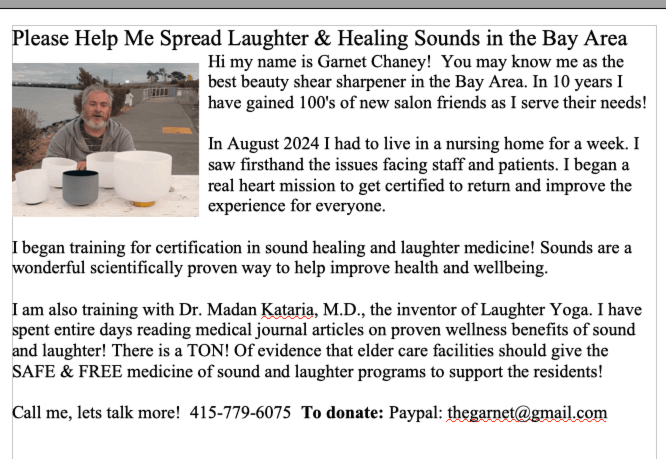
The book Laughing My Way to India and related training materials document one journey of taking laughter practice seriously as both personal healing and service to others. You can explore more of that story and the ongoing laughter ministry work through the main site at thegarnet.net.
"A joyful heart is good medicine!" — Proverbs 17:22
Even practical community businesses can become places of connection and light-heartedness. Local service work, such as the sharpening ministry found at garnetsharpening.com (Sharp-Now), often opens unexpected doors for conversation, encouragement, and shared humanity. And for those who seek healing through sound, garnetsounddesign.com explores sonic sculptures with digital and analog equipment as gentle companions to well-being.
Explore the Full Website Family
Therapeutic humor is a living practice — and it connects to many corners of life. Below is the full family of websites that orbit around laughter, healing, sound, service, and creativity. Each one is a doorway deeper into the world of healing humor.
TheGarnet.net
The central hub. Articles, features, the wiki, and the full story of the Laughing Chaplain ministry — including the book Laughing My Way to India, senior care visits, and laughter training resources.
Visit the Hub →LaughingChaplain.com
Bringing joy to seniors. Services including therapeutic laughter, sound healing, Bible study, and joyful retreats for elder care communities in the Bay Area — at no cost to the residents.
See Services →Laughtarian.com
Be a Laughtarian! The Laughter Yoga community — online sessions, resources, and the Dalmatian Jasper fundraiser stone. Learn the science of intentional laughter and join the global movement.
Join Sessions →LaughterAngel.com
Become a Laughter Angel. Resources for spreading joy in your community, including the official Dalmatian Jasper stone of joy — a tool for healing, playfulness, and breaking down emotional barriers.
Learn More →CapeFearComedy.com
Comedy as healing. A comedy resource and community — because comedy is one of the oldest and most powerful forms of therapeutic humor. Stand-up, improv, and social commentary as medicine.
Explore Comedy →GarnetSoundDesigns.com
Sonic sculptures for well-being. Exploring sound as a gentle companion to laughter. Digital and analog circuits that make sounds — ambient healing music, sound baths, and sonic art.
Listen →GarnetSharpening.com · Sharp-Now.com
Who Sharpens Your Shears? Premium beauty shear sharpening in the Bay Area. But also — a directory of funny things, pictures, and videos relevant to every state. Even practical work can be a vehicle for joy.
Browse the Sharp-Now Directory →90MinuteChallenge.com
Small actions, big impact. A challenge to do something meaningful in just 90 minutes — a perfect framework for scheduling a laughter visit, writing a joke, or calling a friend who needs a laugh.
Take the Challenge →DonutInspired.com
Insights from unexpected places. Because sometimes the most healing ideas come from the most ordinary moments — like a good donut. A space for creative, offbeat inspiration.
Get Inspired →Bible-Bucks.com
Biblical wisdom meets practical wisdom. Exploring the intersection of faith, humor, and practical life skills — because Proverbs 17:22 says a joyful heart is good medicine, and practical stewardship matters too.
Explore →AmericanMoneyFinders.com
Money recovery with a smile. Asset recovery and unclaimed property services. Because financial stress is one of life's biggest barriers to joy — and recovering your money can be the first step to a lighter, happier life.
Find Your Money →Wiki.TheGarnet.net
The knowledge base. Articles, features, and the growing wiki — a living repository of everything from laughter therapy to sound design, from humor pioneers to practical life skills.
Browse the Wiki →Keep Exploring
Therapeutic humor is a living practice. Whether you are a caregiver, a ministry leader, a comedy enthusiast, a sound explorer, or simply someone who wants more lightness in daily life — there is room for you here.
Start with any link above. Follow your curiosity. Laugh along the way.
Visit the Laughing Chaplain Hub →